I recently learned the pin and stretch technique in an online therapeutic yoga class series offered by Centerpoint Studio in Canada. This technique “pins” one area of the body while you move or “stretch” away from it to lengthen the surrounding tissues. Although this technique is often done passively by a practitioner such as a massage therapist, chiropractor, or physical therapist, right on a muscle trigger point it can also be done actively by yourself which is the focus of this blog.
Anchoring vs Pinning
In yoga, anchoring a body part to the ground is commonly cued. For example, in standing poses students are often told to anchor through the feet. Similarly, the sits bones are used as anchors in sitting postures. Anchoring is essentially becoming aware of the contact between our body and the ground beneath. Energetically, anchoring provides support from below and can help to direct our attention to this stable connection which can bring us into the present moment, calm us down, and create a sense of safety for our nervous system. In fact, our bodies will only open when we feel safe. If the nervous system senses danger it will maintain tension to protect us.
“Pinning” on the other hand, emphasizes the physical aspect of continuously pressing down on an area of the body. When done actively, this involves using muscular effort to keep that part of the body still and motionless while we stretch away from the pinned spot to release tightness or restrictions in the fascia, muscles, and other soft tissues.
Pin and stretch is a simple, yet powerful technique that can be added to several movements—yoga poses, flexibility stretches, posture exercises—to increase depth and expand range of motion. Despite these benefits, however, caution needs to be followed to prevent overstretching which can leave joints vulnerable. Fortunately, this is easily accomplished by maintaining a connection to your center during these movements.
Staying Centered with the Pin and Stretch Technique
When we pin and stretch we move the body part away, lengthen the tissues, and then come back to our center. To stay safe with this technique we need to keep connected with our center and feel supported. You can think of your center as your core which is a strong, aligned cylinder of stability extending from your respiratory diaphragm to your pelvic floor and encircled by the deep transverse abdominis muscle. Joints are at risk and injuries happen when we disconnect from our center. As an example, let’s look at a spinal twist.
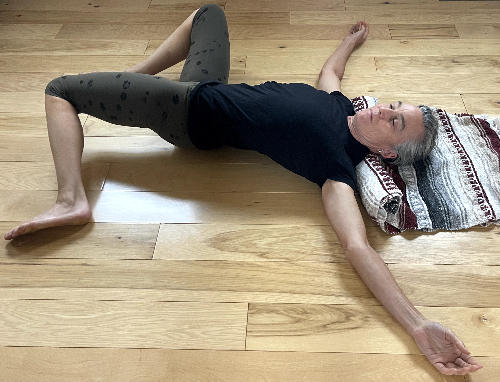
Disconnected Spinal Twist
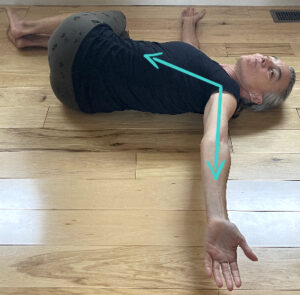
In this twist the shoulder is disconnected from the center and the arm is hanging off the tissues unsupported leaving the joint vulnerable to injury.
Connected Spinal Twist
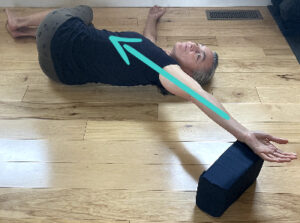
In this twist the arm is connected through the shoulder to the center of the body and the hand is supported. The strength, integrity, and safety of the shoulder joint is maintained in this position by moving the entire torso together into the twist. In other words, there is no independent movement of the humerus (upper arm bone) within the shoulder joint to create the stretch. Moving together, the hand, arm, shoulder joint, scapula, rib cage, and spine all maintain their alignment and orientation with each other in the posture.
Although the stretch may not feel as intense in this connected position, the lengthening is directed appropriately into the chest muscles. Additionally, the block provides an anchor for the body. Providing this support from beneath calms the nervous system which enables the tissues to let go which results in a lasting opening in the area.
Adding Pin and Stretch to 3 Postures
Knee Drop with Neck Pin
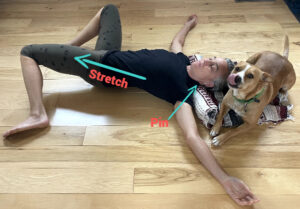
Meet my foster dog, Lolly! She just couldn’t help herself and wanted to be part of the action.
In this posture the neck is pinned on the roller as the body is stretched away from it all the way through the knee. As was mentioned in the class I attended, your mind will naturally lead your attention to the area of greatest sensation. In this posture, that is usually the hips. While holding the position for a few breaths attempt to redirect your focus to your neck and notice the subtle lengthening in the area.
Sitting Straddle with Sits Bones Pinned
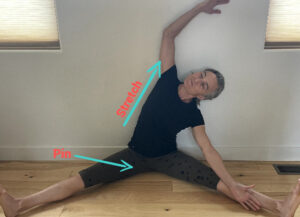
In this posture the right sits bone is pinned to the ground while the upper body is moved away from it and to the left. This same concept applies to any side bending posture whether sitting on the floor, in a chair, kneeling, or standing. However, the pin location will switch to the knees when kneeling and feet when standing.
Kneeling Counter Stretch with Hands Pinned
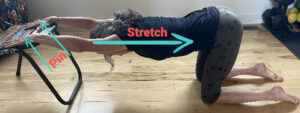
In this posture the hands are pinned to the chair while the body is stretched in the opposite direction to lengthen the back through the spine. Interestingly, this is the same technique that is advised during the downward dog posture. Wrist discomfort, a common problem in the pose, can be reduced when weight and pressure on the upper body is lightened by pinning the hands on the floor, extending through the upper body and pressing the hips back just as much as up.
Conclusion
The pin and stretch technique can be added to many movements to release tissue tightness. Pin and stretch has a physical focus while anchoring, which also emphasizes the tangible connection and support of the body from below, has a more energetic aspect which affects the state of our nervous system. We must feel safe to let go and open fully into a posture. Hence, combining pin and stretch with anchoring is highly effective. Further, staying connected to the center, our core, also keeps us protected in our movements. Consider adding these elements to your routine and notice what changes.